Tuesday, July 24, 2012

The Power of the Arts

Man will begin to recover the moment he takes art as seriously as physics, chemistry or money.  -Ernst Levy

Go into the arts. I'm not kidding. The arts are not a way to make a living. They are a very human way of making life more bearable. Practicing an art, no matter how well or badly, is a way to make your soul grow, for heaven's sake. Sing in the shower. Dance to the radio. Tell stories. Write a poem to a friend, even a lousy poem. Do it as well as you possible can. You will get an enormous reward. You will have created something. -Kurt Vonnegut

The arts are so important to have in education, yet they're the first thing to go in this testing-heavy environment. By phasing the arts out of schools, we are doing a huge disservice to our students. Arts are not a luxury, but a necessity, and as it turns out, correlated strongly with success. Working at an arts-integrated elementary school has only helped fuel my belief in the necessity of the arts.

While I'm sure I could find some other articles to back me up, I'm going to use my personal experience. While numbers go a long way, I think that they are also, to some extent, impersonal. But if you make an issue personal, and put a face to it, I think it goes a lot longer sometimes. It's easy in the abstract to understand there are all sorts of injustices going on in the world, and go about your daily life. It's a lot harder when you can relate to it yourself. So that's what I'm going to do. I think that the arts are not just necessary to keep for low-income students or minority students or what have you, I think the arts are important for EVERYONE.


Take me, for example--I can't imagine my life without art. Growing up, my mom made me create any birthday or thank you card by hand, so for every occasion, I had a little art project to complete. In elementary school, I participated in a couple of theater camps, and had a blast. I love musicals. Most of the more memorable school projects-from elementary school through high school--were the creative projects. From videos about recycling, to creating my own "Brown Bear" book, those are also the projects I hang on to all these years later. Looking back at old notebooks, I doodled like crazy during class--to keep me focussed, or awake, or simply just to keep the boredom from setting in. But I feel like it says something that a lot of kids doodle on their schoolwork.

 In college I was almost an art major. Ended up in psychology, but got so much from the art classes I took. Not only that, but art balanced out my schedule. I felt like my art classes were, in some ways a way to use my brain in a different capacity. It wasn't by any means a break--they were challenging, time consuming courses, but it there was definitely a different feeling when I finished a 2 hour stint in the dark room, versus finishing a big problem set. Throughout college I had fun "borrowing" mugs from the dining hall and drawing on them in sharpie, and then giving them to people because they asked me to. I was also the go-to for various costume tattoos, as well as actual mock-ups of potential tattoos. Apparently I'm good at time consuming activities with lots of details.

My first college art course was observational drawing, the prerequisite for basically any other art class. So many people complained that oh, they would take this or that class if only they didn't have to take observational drawing. And to that I say, there was a damn good reason to take observational drawing before a class like photo. On the first day the professor gave a little lecture about how this course would change the way I look at the world. And I was like, pffffft. Yeah right. But you know what? He was right. I totally see the world differently now--I notice a lot more, and am a lot more aware of various details.


So then I started working in an elementary school where arts is its THING. And all my thoughts and feelings about how great the arts are magnified. Arts are a way to look at the world differently. And never underestimate the power of the arts to help teach math, science, english, and really any subject.

I am amazed at students' ability to memorize lyrics. This is why I now know the counting by 10s song, for example. It is nothing more than counting to 100 by 10s, set to a tune, but without that song, those kindergardeners would struggle much more. I remember being with some 4th graders learning the Fifty Nifty United States song and I was thinking, man this isn't that catchy, how does anyone expect kids to remember them all? But, while I can't (I blame the fact that I never learned this song in grade school), they certainly could.

What's more, is at the end of the year we put on an all-school musical. And the students are just SO into it. Each class has their own song and dance number, but somehow, most students know not only every single song in the entire musical, but most of the dances as well. It's pretty amazing. I think it's also a great way to introduce new vocabulary to these students. The teachers who wrote the songs (they're all original), are very clever. They aren't simplistic lyrics for kids, they're entertaining and full of puns and interesting references. The students may not always know what the words mean, but it's a step in the right direction. Having a larger vocabulary can help advance a student in reading and comprehension. Maybe they've never seen a word written down, but when applying their rules for sounding out new words, they will be able to make the jump to figuring out the word if it's one they've heard.

Beyond academics, the arts give a good balance to students who may have some behavior issues. Maybe it stems from some classroom insecurities, and excelling in dance gives them some extra self esteem, but also gives a teacher a way to see the child in a new light. So the arts don't just make life less boring, but can have very tangible, positive results for successful academic endeavors and relationships.

Moral of the story, ART is education disguised as FUN. What more could you want?

Thursday, July 19, 2012

And as we go on/we remember/all the times we/had together


"Why can't we get all the people together in the world that we really like and then just stay together?  I guess that wouldn't work.  Someone would leave.  Someone always leaves.  Then we would have to say good-bye.  I hate good-byes.  I know what I need.  I need more hellos." –Charles M. Schulz

"Some people come into our lives and quickly go. Some stay for a while, leave footprints on our hearts, and we are never, ever the same." – Flavia Weedn 

June 30th marked the end of my AmeriCorps service, but lucky for you Dear Reader, not the end of my blog! Not only do I still have plenty of thoughts I have yet to get down on paper for your reading pleasure from my service in St. Paul, but I'll be starting a new chapter in my life! I just moved back to my hometown of Davis, California where I'm starting grad school, and will be student teaching in the neighboring town of Dixon. Super excited. 

I know it's been over a month since my last post, but I was a guest writer for the Minnesota Reading Corps blog this month, so that was exciting. You can read my post, about what I learned from Reading Corps Training that will help me in my life after AmeriCorps. (This post was a little more professional than my thoughts last August, right after training). Ultimately, just like even though I graduated from Carleton in 2010, I'm still very much a Carl, and even though my service years are over, it's not a chapter that is closed in my life. I still intend to visit my old school, and my amerifriends, and of course all of my other friends back in Minnesota as often as possible. 

I'd like to think that I made an impact in those two short years with my students, but who knows? (The Onion has an idea). I know my students became better readers, so there's that. And now I'll embark on a journey to help even more children. And now I'm in Davis. The other day I was in Minnesota--it hasn't hit me that I'm not going to go home to my good old duplex and awesome roommates in a week.

So here's to hellos and goodbyes--meeting new people at UCD, and new students and teachers, learning a lot and being close to family. And to visiting Minnesota soon!

Monday, June 4, 2012

Beyond The Numbers

Grown-ups love figures.  When you tell them that you have made a new friend, they never ask you any questions about essential matters.  They never say to you, "What does his voice sound like?  What games does he love best?  Does he collect butterflies?" Instead, they demand:  "How old is he?  How many brothers has he?  How much does he weigh?  How much money does his father make?"  Only from these figures do they think they have learned anything about him.  -Antoine de Saint-Exupéry

Children ask better questions than adults.  "May I have a cookie?" "Why is the sky blue?" and "What does a cow say?" are far more likely to elicit a cheerful response than "Where's your manuscript?" Why haven't you called?" and "Who's your lawyer?"  -Fran Lebowitz

The 3rd-6th graders at my school took the MCAs recently, the required standardized test Minnesota uses to measure the success and progress of its schools. It's really not a measure of my school's success though, because half of our students are new this year. How can you say, oh, you're a good/bad school when some students have been with us for not even a year? Our scores are not a measure of what we're doing, but of our students, whether or not they've had the opportunity to learn much here yet.

Next year, we're getting a science teacher, as are a lot of St. Paul schools. I'm pretty sure the only reason we're getting science, is because we'll be tested on it. How sad is that? Yeah, there are some science standards, but no one cares if our kids are learning science, because we have to make sure they can pass the MCAs, which don't (but might in the future) include science. 

So much of a focus on the tests, that you lose what's important: instilling a love of learning and critical thinking skills necessary to problem solve on your own. There is something to be said for cultural literacy. Also, making school interesting. Some of the passages I sort through to read with my kids make me cringe. How can I get my students excited about reading when even I can't muster up the enthusiasm to read a boring "story." If you can call it that. My dad sent me this article that I think really speaks to this problem.

"Better yet, we should abandon altogether the multiple-choice tests, which are in vogue not because they are an effective tool for judging teachers or students but because they are an efficient means of producing data."

It's becoming very clear to me that the standardized tests we have in place might be doing more harm than good. I understand the importances of quantifying/assessing teaching, but it needs to be more comprehensive, and depend on more than simply one day in a year. Yes, that's more work, more complicated, maybe a little less objective than a multiple choice test, but it's more accurate, and more fair to teachers like these who put their hearts and souls into their work, see amazing growth in their students only to be told by some outside party who probably hasn't set foot in their school that they're failures.

Thinking about the MCAs versus the weekly progress monitors I've done made me realize that testing should be more ongoing, than based on one day. Even if my student doesn't do well one week, I have a lot more data and context to look at, and I can still feel like I'm a success as a tutor. So on this one arbitrary test day, a student doesn't do well. Is that a reflection of his school? Possibly, but maybe he was sick for a week and missed school. Maybe his grandfather died. Maybe he's not getting enough to eat. Maybe he had a rough morning. Who knows? Well, the teacher does. And if there were ongoing assessments, we would know that the trend of his learning may still be at or above grade level, even if this ONE specific day out of the year was below.

Plus I can feel happy knowing the difference that I made was significant, even if my students are still reading below grade level, because I know where they started. The gains they made are sometimes equivalent or greater than what an "average" student makes in a year, they just started way further back. If I just looked at the 3 scores from fall, winter, and spring, I think I'd feel like a bit of a failure. But when I take the time to look a little deeper, at my weekly assessments and at each individual kid's story, well, I feel good about what I've accomplished this year. I'm a success, and I've made a difference.

Probably one of my happiest-this-is-why-I-do-this moments in the past month was when the first thing one of my third graders said to me at the beginning of our session was "I like reading with you Ms. Amy." It was nothing extraordinary, and doesn't make for a great story. But it was the best thing I could possibly have heard, and made my day. I love my job.

Monday, May 7, 2012

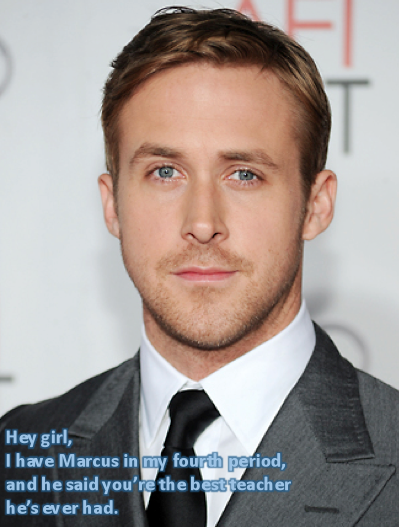
Hey Girl, I Appreciate You

“Education is what remains after one has forgotten what one has learned in school.” -Albert Einstein


Apparently it's National Teacher Appreciation Week. With that in mind, I'd like to take a moment and step back from being critical of our education system, and think about what's right in our schools. Namely, our teachers.

For great teachers, the job is less a career than a calling. You don’t become a teacher to make a world of money. You become a teacher to make a world of difference.

I'd like to take a moment to thank some great teachers (and educators) I've had. I had an epiphany during an education class I took. It wasn't anything special, it was just realizing what I knew all along. I could never quite place why my all time favorite teacher was my all time favorite. Why he was such a good teacher. It wasn't the subject--I entered his class expecting to have a boring year. Boy, was I wrong. And I think the subject could have been literally anything, and I would have had a good year. It was because he was so passionate about both his subject and teaching. Enthusiasm is contagious.

So here's to Mr. Williams, my US History teacher, who not only got me interested in US History, but also gave me a model of the kind of teacher that I would like to become. Who let each student be more than just a face in the crowd. Who I will continue to visit, years out of college, even though most students stop visiting their high school teachers after sophomore year of college.

To Mrs. Bruch, who decided to show our sci fi class American History X, not because it was sci fi, but because it's a powerful, thought provoking movie. Whose class I aced, but that fact is wholly unrelated to how successful I felt it was.

To Mrs. Russell, my Jr. High English teacher who taught me how to write, to whom I thank for my success in any writing endeavor since then.

To Mme. Harvey, who gave me a strong foundation in French in Jr. High, that carried me through High School and enabled me to actually place out out 3 levels of college french.

To Coach Day, who may have talked a lot, but taught me so much about horizontal jumping technique, and helped fuel my passion for track.

To Mr. Reevesman, who made 4th grade in a new school the best it could be. Who let us mimic trench warfare with crumpled paper and lines of desks, and made each of us the faces of our class currency.

To Cathy, who reminded me that I do love French.

To Deborah, who inspired my passion for education, whose class gave a directionless senior a path to follow, and continues to be a supportive guiding force in my journey to becoming a teacher.

To Donna, my first introduction to Carleton, who encouraged and helped me through one of track's hardest events, and who was consistently there to support me all four years.

To Mrs. Pappas, my Minnesota mom, who not only is one of the most amazing elementary teachers I know, who I can only hope to be half the teacher she is, but also a friend that will be so hard to say goodbye to when I go back to California this summer.

To my parents, who may not have officially been teachers, but whose support pushed me to be successful in school, and who I still rely on for guidance in just about any aspect of my life.

To all my teachers I haven't mentioned. Some of you, like in any profession, weren't the best. (But hey, now I know what not to do!) But most of you did a pretty good job. Most of you made a significant positive difference in my life. And I thank you for that, because I couldn't have made it to where I am now without you.

I'll end with something great to come out of the "Hey Girl" Ryan Gosling internet explosion: this site. Because hey, we all need a little reassurance that teaching IS hard, and you are, indeed, doing a good job.


Friday, April 13, 2012

Tale As Old As Time

 Through the mist, through the woods,
through the darkness and the shadows.It's a nightmare but it's one exciting ride.
New and a bit alarmingWho'd have ever thought that this could be?True that he's no Prince CharmingBut there's something in him that I simply didn't see
(Beauty and the Beast)

            In the fall of 2010, I was about to begin my first job after graduation. I was a little nervous to be working at a primarily non-white, non-middle class school, which was different from my own school and life experience. Nervous not about the students, but about me. How was I going to react? How would I feel? I was out of my comfort zone: living in a big city for the first time, relying on public transportation, and working with children whose histories were in many ways completely different from my own. It is like in the Disney movie Beauty and the Beast, when the villagers are storming the castle where the Beast lives. They sing "We don't like what we don't understand and in fact it scares us and this monster is mysterious at least." It's the difference that creates these rifts between groups, because no one took the time to get to know the other, and discover that different does not make one characteristic better or worse than another. Belle knew better because she took the time to get to know the Beast. Because I was not entirely sure what to expect, I entered my job with an open mind, ready to learn, ready not to make the mistake of the villagers but to give difference a chance, à la Belle.

It turned out to be a very smooth transition. The differences between my students and me were important not because they were differences, but because each one meant a different story that affected how a child learned.   In the end, it was not too difficult to find common ground with every one of them. I may not have the same skin color as my students, but that did not stop one African American student from proclaiming that he wished I was his mother. I made an effort to get to know my students as individuals to learn how to best help them. I had more things to worry about than the color of each student’s skin when I was focused on bringing them up to grade level in reading or math.

My school requires students to wear uniforms, which helps diminish some socioeconomic status symbols, but my students’ histories began to emerge, and with that I began to learn the most important lesson about successfully interacting in this diverse environment: Don’t assume anything. My previous picture of what comprises general knowledge or common childhood experiences had to change. I could not assume anything about my students’ situations and thus had to be wary of making one of them feel uncomfortable with a seemingly harmless comment. It affected everything from the smallest detail, such as my freckles, to life altering details such as talking about parents. You quickly seek alternative ways to phrase these questions when a kindergartener shuts down because asking about their father leads to learning he is in jail. While at first it was a very conscious effort, it now just rolls off the tongue to ask for a parent, grandparent, auntie or uncle’s signature on an assignment versus asking for a mother or father’s. Education, in many ways, must be personalized for each student in order to optimize his or her learning.

Humans are adaptable and I am no exception. After a couple of months into the year, I felt very comfortable at work, even though it was quite different from every other place I had worked or lived. My job has enabled me to think about opportunity and privilege in a way I had not before. When I look at the beautiful rainbow of my students I realize that putting yourself into new situations, as long as you shed your assumptions and get to know your surroundings personally, can be incredibly rewarding. A good relationship can transcend the superficial differences that separate us and you may find out that what you did not understand is not so different after all.

Wednesday, February 29, 2012

A Memory and A Predicament

"We recognize our own mortality, and we are reminded that in the fleeting time we have on this Earth, what matters is not wealth, or status, or power, or fame -– but rather, how well we have loved -- and what small part we have played in making the lives of other people better." -President Barack Obama

"There is nothing wrong with America that cannot be cured by what is right with America." -Bill Clinton


Something wasn’t quite right. I could not simply enjoy this performance, a boys choir visiting our school. It wasn’t their voices—they were lovely. As my eyes panned to the audience, checking to make sure my students were being the respectful audience they had been taught to be, I realized what unsettled me. And when the director invited my students to think about joining the choir, I knew full well that the likelihood of any of my students joining was slim. It wasn’t for the reason the director brought up—that a year-round school schedule wouldn’t fit with the choir’s schedule. It was socioeconomic status, and in an interconnected way, race.

What had made me stop and think was that seeing an all-white group of boys perform to my much more diverse school brought to mind the inequalities prevalent in our society today. Even if one of my students had the means to pay for the expenses of this elite boys choir, would they feel welcome? Watching this homogeneous group, would they think joining was even an option? This may be a small example, but people tend to internalize what they see, and so on some levels, children may not realize the wealth of opportunities available to them if there’s no one like them currently occupying those roles. We can trace this issue back to the disparities in education where children get their first ideas about what is expected of them and what they have the potential to accomplish.

On a related note, there is one thing I feel conflicted about in becoming a teacher. As a white female, I am just like just about every other elementary teacher out there. And I see that there is a need for strong male role models in the lives of my students. I'm not helping the ratio. What makes me qualified for really any sort of advocacy, when I don't fall into most of the disadvantaged groups? Except for being female, so of course I go into the profession where we're most well represented. I want to make a difference, but I know that some criticism of hollywood's portrayal of successful teacher stories is that it's always some "white savior" who swoops in and rescues these kids from gangs, death, jail or what have you. How can I advocate for my students without coming across as condescending, or racist? How can I make a difference in the places that most need good teachers, but who also need role models who represent the students, both in gender and race?

I don't really want to work in some upper middle class (mostly white) neighborhood where the teaching is "easy". Okay, teaching is never easy, but those kids don't need my help, they're going to be fine and successful, and I feel like I have a lot to offer, and that can be best placed in a high need area. I can't really say why this is where I want to teach; it certainly isn't the easy way out. Maybe it's the incredibly positive experience I've had the past two years. Maybe it's that, while I have not encountered huge injustices that impact me personally, I have now seen the results of the inequalities in America in the touching stories of my students. That on some basic level, I believe in America's ability to follow through on its ideals of equality. And I believe in the power of education to right some of America's current predicaments. I suppose it comes down to my moral compass. I'm basing this on my principles versus experience. Otherwise I'm just perpetuating the status quo, and that's not going to be good for anyone in any class.

Tuesday, February 14, 2012

Count Your Blessings

Always jump in the puddles!  Always skip alongside the flowers.  The only fights worth fighting are the pillow and food varieties.  -Terri Guillemets

Maybe we should develop a Crayola bomb as our next secret weapon.  A happiness weapon.  A beauty bomb.  And every time a crisis developed, we would launch one.  It would explode high in the air - explode softly - and send thousands, millions, of little parachutes into the air.  Floating down to earth - boxes of Crayolas.  And we wouldn't go cheap, either - not little boxes of eight.  Boxes of sixty-four, with the sharpener built right in.  With silver and gold and copper, magenta and peach and lime, amber and umber and all the rest.  And people would smile and get a little funny look on their faces and cover the world with imagination.  -Robert Fulghum


More often than not, this blog is where I can rant, and ranting is usually critical or negative. Now, I consider myself to be a very optimistic person, but think that perhaps my outlook seems dire on the state of education in America, or even my students. I love my job, yet does that come across in my writing? I hope so, but if it doesn't, I'm going to make a more conscious effort to share the positive side of my job.

I'm on the Communications Committee with Reading Corps, and we're doing a lot of recruitment efforts. Part of that is writing articles for college newspapers to spread the word. Naturally, I wrote one for my alma mater. I added the link to the article to our Committee's Google doc., and the next thing I knew, all of my bosses/program coordinators I didn't even know had read it, and loved it. My supervisor must have sent it to my principal, because the next thing I know, I had teachers telling me they really liked the article. I was glad--I initially felt insincere, putting together this op-ed, because I wanted it to be my voice, that even though I was promoting Reading Corps, it was also my experience that I was sharing with Carleton. I wanted it to be worthy both of my amazing Carleton experience, and my experience with my current school.

From this experience, I learned that I don't know how to take praise, or at least am a little uncomfortable with it. I don't know what to say. It was a good ego boost to know that something I wrote could impact so many people who weren't necessarily the intended audience. I suppose it was good that it went out to the staff at my school--I'm not always the most talkative and outgoing at work, so while the article doesn't express anything that would be a surprise to you, dear reader, it's something that a lot of my co-workers don't know. I also never consider writing to be one of my strengths, but a lot of the commenters on my article mentioned my good writing. So much of what I do--as is characteristic of many jobs in which you're serving others--goes uncommented on. It's good to know that something you're doing does actually make a difference in the here and now.

The brightly colored "no sweets" signs at school last year

In related news, today was Valentine's Day, which is just a happy day in an elementary school. Plus, you always have a Valentine (or 20) when you work with kids. It's a good reason to say screw the "no sweets in SPPS public school" rule, and give out cards and candy and love. Really though, had we tried to enforce the "no sweets" rule, it would have been like trying to put out a fire using paper. At any rate, I gave my students Valentines, and got some in return. All my students were in good moods, no one was absent (so rare!), and no one had a bad day. It was one of those days that made me remember why I do what I do. (Lucky for me, I have moments like that everyday...but rarely can I say that about the entire day.)

My third grader, the one who made me cry, was in a very good mood. Today she asked me why there had never been a woman president. She also stated that she wanted to be president one day. Naturally, I turned the conversation to "what do you need to do to become president?" And like the clever student she is, she starts with "confidence," and then added "needs to be a good reader." Bingo!